Is mustard oil good for hair? Regrowth and grey hair myths
Is mustard oil good for hair? It is a fine winter conditioner, but the big promises do not hold up. What it can do, what it cannot, the dandruff catch, and a safe routine that starts with a patch test.

Is mustard oil good for hair? Yes, as a conditioner: it softens dry hair, helps with combing and may reduce breakage. But there is no clinical evidence that it grows back lost hair or turns grey hair black, and it does not clear dandruff. Its pungent compound can also irritate some scalps.
Across Punjab, Bengal, Bihar, Pakistan, Bangladesh and Nepal, sarson ka tel is the winter hair oil many of us grew up with: warmed in a steel katori, worked into the scalp in the sun, with a promise that it would make hair long, thick and black. Some of that is real. Some of it is hope. Here is how to tell them apart.
At a glance
- Like most plant oils, mustard oil coats the hair shaft, reduces friction and can cut breakage.
- No clinical study shows that mustard oil grows new hair or brings back colour to grey hair.
- It does not clear dandruff, and heavy oil on a flaky scalp can make things worse.
- Its sharp smell comes from allyl isothiocyanate, a compound that can sting or irritate skin, so patch test first.
- Once or twice a week, for 30 to 60 minutes before washing, is plenty.
Can mustard oil regrow hair?
Myth: mustard oil grows back lost hair. Fact: there is no good evidence that it does. Hair grows from follicles deep in the skin, and most hair loss has causes an oil cannot reach:
- Pattern hair loss, set by genes and hormones, the most common kind in both men and women.
- Shedding after a shock to the body, such as a high fever, childbirth, surgery or crash dieting, which usually settles within months.
- Low iron, thyroid problems and some medicines.
- Round, patchy loss, which can be an immune condition called alopecia areata.
What mustard oil can do is protect the hair you already have. Oiled hair tangles less, so less of it snaps when you comb it, and ends that do not break make hair look longer and fuller over time. That is a real benefit, but it is not new growth. If you are losing more hair than usual, see a dermatologist: some causes, such as low iron or a thyroid problem, show up on simple blood tests.
Does mustard oil turn grey hair black?
Myth: mustard oil turns grey hair black. Fact: no oil can put colour back into grey hair. Hair turns grey when pigment cells in the follicle gradually stop making melanin, the pigment that colours hair. When that happens is decided mostly by your genes and age.
Oiled hair can look a shade darker and glossier for a day, because it reflects light differently, the way wet hair looks darker. That fades with the next wash. If you are greying unusually early, for example before your mid-twenties, mention it to a doctor, because low vitamin B12 and thyroid problems are among the causes worth checking. For colour, henna, indigo or hair dye are the honest routes.
Is mustard oil good for dandruff?
Myth: mustard oil clears dandruff. Fact: it does not, and it can make some dandruff worse. Dandruff is linked to Malassezia, a yeast that lives on the scalp and feeds on fats. In a 2023 letter in the journal Skin Appendage Disorders, dermatologists pointed to laboratory tests in which this yeast grew on plant oils such as olive and coconut oil, and suggested that people prone to flaking keep oils off the scalp and on the hair lengths instead.
For dandruff, the American Academy of Dermatology suggests shampoos with ingredients such as zinc pyrithione, ketoconazole, selenium sulfide or salicylic acid, lathered onto the scalp and left for about five to ten minutes before rinsing. Small, dry, white flakes in winter can simply be a dry scalp, which a little oil may help; greasy, yellowish, itchy flakes are more likely to be dandruff.
Is mustard oil good for hair, or is coconut oil better?
Neither is best for everyone. Coconut oil has the stronger evidence; mustard oil has the stronger tradition in the north and east.
| Mustard oil | Coconut oil | |
|---|---|---|
| Feel and smell | Thicker, warming, pungent | Lighter, mild |
| In winter | Stays liquid | Turns solid below about 24°C (75°F) |
| Evidence | Not studied for hair damage | Reduced protein loss in a 2003 laboratory study |
| Tradition | Punjab, Bengal, Bihar, Nepal, Pakistan, Bangladesh | Kerala, Sri Lanka, coastal India |
| Take care | Can irritate sensitive scalps | Can feel heavy on fine hair |
That 2003 study, by Rele and Mohile, found that coconut oil reduced protein loss from hair when used before washing, while sunflower and mineral oils did not. Mustard oil was not part of it, and we know of no comparable study for mustard oil, so we simply do not know whether it does the same. For a wider comparison, see which oil suits your hair.
Can we apply mustard oil on hair? A safe routine
Yes, most people can, with a little care.
- Patch test. Dab a few drops on the inside of your elbow and wait 24 hours. Skip it if you see redness, itching or burning.
- Warm it gently. Stand a small katori of oil in warm water until it is just warm, never hot.
- Use a little. One to two teaspoons (5 to 10 ml) is enough for shoulder-length hair.
- Massage softly with your fingertips, not your nails, for three to five minutes. Our guide to champi, the warm-oil head massage, shows how.
- Leave it 30 to 60 minutes. Overnight is not needed, and on a sensitive scalp it raises the chance of irritation.
- Wash it out well, applying shampoo to the oiled hair before adding water. See how to wash hair oil out without stripping your hair.
- Repeat once or twice a week, not every day.
Who should skip mustard oil on the scalp
- Anyone with eczema, psoriasis, a very sensitive scalp or a past reaction to mustard. Mustard is a recognised food allergen in the EU and Canada.
- People prone to dandruff or seborrhoeic dermatitis: keep oil on the lengths only.
- Anyone with broken, sunburnt or infected skin on the scalp.
- Babies and young children: its pungency can sting, and it must never go near the eyes.
- Anyone with sudden, patchy or heavy hair loss: see a doctor first.
If you have heard that mustard oil is banned in America, our explainer on what the "banned in America" story actually means sets out the facts.
Our mustard oils
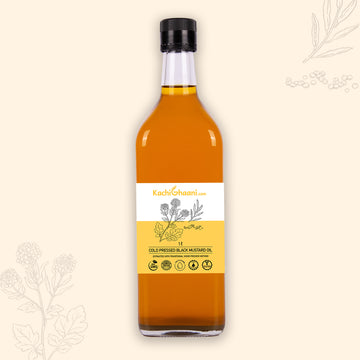
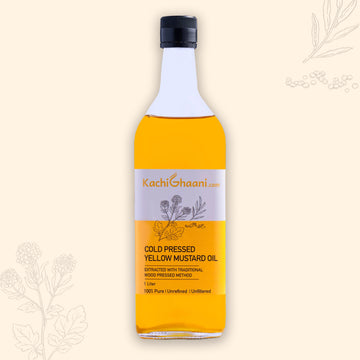
Our Truly Cold Pressed black mustard oil and yellow mustard oil are both pressed slowly in wooden ghaanis and left unrefined, so they keep the full, sharp aroma a winter champi is known for. Pick the one whose smell you enjoy, patch test first, and use it for what it does well: soft, protected hair.
The bottom line
Mustard oil is a good, warming conditioner that can make hair softer and less likely to break. It will not grow new hair, darken grey hair or clear dandruff, and it can irritate sensitive scalps. Patch test, keep it to once or twice a week, and see a doctor about real hair loss.
Frequently asked questions
Can mustard oil stop hair fall?
It can reduce hair breaking off along the length, which many people count as hair fall. It cannot stop hair shedding from the root, which has causes such as genes, hormones, illness, low iron or thyroid problems. If you see clumps on your pillow or comb, or bald patches, see a dermatologist rather than oiling more.
Does mustard oil help hair growth?
Not directly. There is no clinical evidence that mustard oil speeds up hair growth, and hair grows at much the same pace whatever oil you use. Hair that breaks less does keep more of its length, though, so regular, gentle oiling may help long hair look fuller over time.
Is it okay to leave mustard oil in hair overnight?
For most people it is not needed. Thirty to 60 minutes is enough to soften hair before washing. Leaving it overnight keeps its pungent compound on the scalp for many hours, which raises the chance of itching or irritation, and can make flaking worse if you are prone to dandruff.
Can mustard oil cause hair loss?
There is no evidence that mustard oil itself causes hair loss. But it can irritate some scalps, and an inflamed, itchy scalp that is scratched a lot can lose hair. If it stings, itches or reddens your skin, stop using it and wash it out with a gentle shampoo.
Should mustard oil be mixed with other oils for hair?
You can. Mixing one part mustard oil with one or two parts coconut or almond oil softens its smell and pungency, which suits sensitive scalps. Patch test the mix too. Some families warm the oil with methi seeds or curry leaves; strain it well and let it cool before use.