Does coconut oil help sunburn or work as sunscreen?
Does coconut oil help sunburn, and can coconut or sesame oil work as sunscreen? What the evidence says about their SPF, what to put on a fresh burn, and when oil helps.

Does coconut oil help sunburn? Not while the burn is fresh, and it is no substitute for sunscreen either. Lab tests put its sun protection in the single digits at best, far below the SPF 30 dermatologists recommend. Cool new sunburn first; once the heat has gone, a little oil can ease dry, peeling skin.
The idea is everywhere on social media, and it sounds sensible: coconut and sesame oils come from sunny places, feel soothing and smell of holidays. But a sunscreen has a precise job, and a sunburn needs cooling, not sealing. Here is what the evidence shows, what to do for a fresh burn, and where oil genuinely helps.
At a glance
- Coconut oil has no tested, labelled SPF; small lab studies suggest single-digit protection at most.
- SPF 30 blocks about 97 percent of the sun's UVB rays; dermatologists recommend at least that, broad spectrum, reapplied about every two hours.
- Sesame oil is no better: claims that it blocks 30 percent of UV rays have no reliable human testing behind them.
- On a fresh sunburn, get out of the sun, cool the skin, use aloe vera or an unperfumed moisturiser, and drink water.
- Once the heat settles, a thin layer of oil can soften dry, peeling skin.
Can you use coconut oil as sunscreen?
No. A sunscreen is designed and tested to absorb or reflect ultraviolet (UV) light evenly across the skin, and it must pass standard tests on people before it can claim an SPF on its label. Coconut oil has never been shown to do that. A thin, uneven film of oil also rubs off, sweats off and washes off, so whatever little it filters in a laboratory is lower still on a real beach day.
Dermatologists recommend a broad-spectrum, water-resistant sunscreen of SPF 30 or higher, reapplied about every two hours and after swimming or sweating. Most adults need about 1 ounce (roughly 30 ml, a shot glass full) to cover the body, and at least a teaspoon for the face. Shade, hats and covering clothes do the rest.
Does coconut oil have SPF?
Not a meaningful one. Small laboratory studies that measured oils in an instrument, rather than on human skin, have estimated coconut oil's sun protection in the single digits. For comparison, the American Academy of Dermatology notes that SPF 30 blocks about 97 percent of UVB rays, the main cause of sunburn. SPF also says nothing about UVA, the deeper rays that mainly drive skin ageing, which is why broad spectrum matters on a label.
| Option | SPF tested on human skin? | UVA protection tested? | Use for sun protection? |
|---|---|---|---|
| Coconut oil | No | No | No |
| Sesame oil | No | No | No |
| Broad-spectrum sunscreen, SPF 30 or higher | Yes | Yes | Yes, reapplied about every 2 hours |
| Shade, hats and covering clothes | Not applicable | Not applicable | Yes, alongside sunscreen |
Does sesame oil block UV rays?
Not enough to count. You will often read that sesame oil blocks about 30 percent of UV rays. We could not find reliable human testing behind that figure, and even if it were true, blocking 30 percent is a long way from the 97 percent blocked by SPF 30. Untoasted sesame oil has a real place in Indian body care, especially warm oil massage, but sun protection is not part of it. Our guide to til, gingelly and sesame oil covers its everyday uses.
Does coconut oil help sunburn?
Not on a fresh burn, but it can help later. A new sunburn is hot, inflamed skin, and it needs cooling first. The NHS advises cooling the skin with a cool shower, bath or damp towel and using after-sun or an unperfumed moisturiser, and it warns against petroleum jelly on sunburnt skin. Its general burns advice is not to put creams, oils or butter on burns. A heavy layer of coconut oil does nothing to cool the skin, so leave it for later.
So is coconut oil good for sunburn at all? Later on, yes. Once the skin no longer feels hot, usually a few days on, it turns dry and tight and starts to peel. Then a thin layer of oil, smoothed on after a lukewarm shower, can soften the dryness and make peeling skin more comfortable. Do not pull or scrub the peeling skin; let it come away on its own.
What should you put on a fresh sunburn?
Cool it, calm it and protect it. These steps follow advice from the American Academy of Dermatology and the NHS:
- Get out of the sun, indoors if you can.
- Cool the skin with a cool shower, bath or damp towel. Do not use ice or ice packs.
- Apply a moisturiser containing aloe vera or soy, an after-sun product, or an unperfumed moisturiser.
- Drink extra water, and skip alcohol.
- For pain, ask a pharmacist which painkiller suits you.
- Leave blisters alone, and do not pop them.
- Wear loose, soft clothes, and keep the area out of the sun until the skin has fully recovered.
Get urgent medical advice if your skin is blistered or swollen, if you have a high temperature, chills, dizziness, a headache or muscle cramps, or if a baby or young child is sunburnt.
Who should be extra careful in the sun?
- Babies and young children: keep babies out of direct strong sun, and get medical advice for any sunburn in a baby or young child.
- Fair skin, many moles or a history of skin cancer: take extra care, and ask a dermatologist about regular skin checks.
- People on certain medicines: some antibiotics, acne medicines and other drugs make skin burn more easily; ask your pharmacist.
- Acne-prone skin: heavy oils on the face can clog pores for some people.
- Allergies: patch test any oil you have not used before on a small area of unburnt skin.
How we suggest using our oils
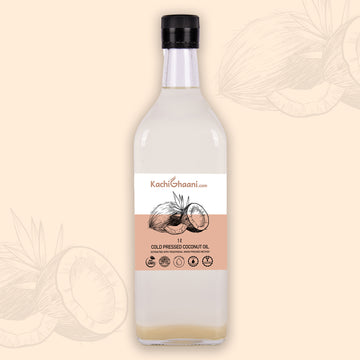
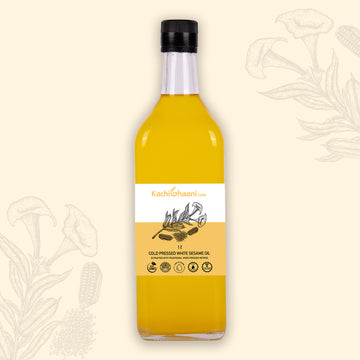
Keep the sunscreen for the beach and the oil for afterwards. Once a sunburn has stopped feeling hot, a few drops of our Truly Cold Pressed coconut oil, pressed from dried copra in a wooden ghaani, can soften dry, flaking skin; our guide to how our coconut oil is made and used explains more. Our Truly Cold Pressed white sesame oil suits a warm body massage on ordinary days. Neither is a sunscreen.
The bottom line
Coconut oil is not a sunscreen, and it is not the first thing to reach for on a fresh sunburn. Use a broad-spectrum SPF 30 or higher and shade to protect your skin, cool a burn with water and aloe, and save the oil for the dry, peeling days that follow.
Frequently asked questions
Does coconut oil make you tan faster?
Oil adds no protection, and people who use it to tan are simply letting more UV reach their skin. Dermatologists regard a tan as a sign of skin damage, not of health. If you want colour, a self-tanning product is the safer route, with sunscreen whenever you are outdoors.
Can I mix coconut oil into my sunscreen?
No. Diluting sunscreen with oil, or layering oil over it, can spread the product unevenly and reduce the protection printed on the label. Apply sunscreen on its own, as directed, and let it settle. Keep oils for the evening, or for days when you are not relying on sunscreen.
Is aloe vera better than coconut oil for sunburn?
For a fresh burn, yes. The American Academy of Dermatology suggests a moisturiser with aloe vera or soy to soothe sunburned skin, and both feel cool and light. Coconut oil is better kept for later, once the heat has gone and the skin is dry and peeling.
What is the best natural sunscreen?
Shade, hats, sunglasses and covering clothes are the most natural protection there is. For a cream, look for a broad-spectrum SPF 30 or higher; mineral sunscreens with zinc oxide or titanium dioxide suit people who prefer simpler formulas. Plant oils on their own are not tested or labelled as sunscreens.
Can I put coconut oil on my face after a day in the sun?
If your skin is not acne-prone, a thin layer can help once any redness and heat have settled. Cleanse first, use only a few drops, and keep it away from the eyes. If you break out easily, a light, unperfumed moisturiser is the safer choice for your face.